

President Donald Trump is facing fresh ethics questions after financial disclosures showed he bought up to $5 million in stock in Axon Enterprise, the company best known for making Tasers and police body cameras, shortly before Immigration and Customs Enforcement pursued a major Taser purchase.
According to reports, Trump purchased between $1 million and $5 million in Axon shares on February 10, 2026. About two weeks later, ICE announced plans to buy roughly 17,800 new energy weapons as part of a potential five-year contract worth up to $220 million.

The timing has drawn attention because Axon is widely associated with Taser products and could benefit from federal efforts to expand immigration enforcement equipment. The proposed ICE purchase would significantly increase the number of Tasers available to immigration agents.
The contract has not been reported as finalized, and there is no public evidence that Trump personally influenced the procurement process or that Axon knew about his stock purchase. However, ethics watchdogs say the sequence raises questions because the president’s administration was pursuing a policy that could benefit a company in which he had invested.
The White House has denied any conflict of interest. A spokesperson said Trump acts in the best interests of the American public and rejected criticism of the stock purchase as a political attack.
Still, the story has intensified debate over whether presidents and other senior officials should be allowed to actively trade individual stocks while in office. Critics argue that even if no law is broken, the appearance of a possible conflict can damage public trust.
Axon is a major law enforcement technology company. It manufactures Tasers, body cameras, dash cameras, digital evidence software, and artificial intelligence tools for police and public safety agencies. The company has thousands of law enforcement clients and has increasingly positioned itself as a broader public safety technology platform.
ICE’s proposed purchase came as the Trump administration continued expanding immigration enforcement. The plan called for about 17,800 new Tasers, unlimited cartridges, and training for agents over a five-year period. Reports said ICE already had about 4,300 Tasers in the field, meaning the new purchase would represent a major increase.

Supporters of the equipment purchase argue that Tasers can give law enforcement officers a less-lethal option during dangerous encounters. ICE documents reportedly described the devices as useful for creating distance and helping agents de-escalate hostile situations.
Critics see the issue differently. Civil liberties groups and some Democrats warn that arming immigration agents with thousands of additional Tasers could increase the risk of excessive force, especially during raids, protests, and high-tension enforcement operations.
That policy debate is now mixed with questions about Trump’s personal finances. The Independent reported that Axon’s share price jumped by more than 34 percent in the week after the ICE solicitation, according to a CNBC analysis. That kind of movement can make even a small timing difference politically sensitive.
Financial disclosure forms often report stock trades in broad ranges, so the exact size of Trump’s Axon purchase is not publicly clear. The reported range of $1 million to $5 million means the investment could have been significant, but not precise enough to calculate exact gains or losses without more detail.
Reports also said Trump continued to buy and sell Axon shares in February and March and appeared to retain at least a six-figure position in the company during the disclosure period.
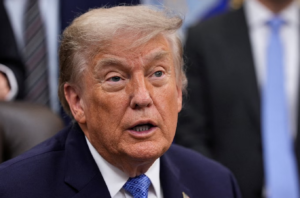
The controversy adds to broader scrutiny over Trump’s stock trading during his second term. NOTUS reported that Trump made thousands of individual stock and financial trades during the first quarter of 2026, including investments in companies connected to government contracts, technology, defense, and immigration enforcement.
The issue is not limited to Axon. Trump has also faced questions over trades involving companies such as Palantir, Nvidia, Microsoft, Boeing, Amazon, and Alphabet. Some of those companies have major business before the federal government or operate in sectors heavily affected by administration policy.
Ethics experts have long warned that public officials can face conflicts when they own individual stocks in companies affected by government decisions. Even if an investment is handled by a third party, critics argue that disclosure timing, policy decisions, and contract awards can still create public concern.
The White House position is that Trump’s assets are managed in a way that avoids conflicts and that he is not making decisions to benefit himself financially. Supporters also argue that wealthy public officials often have broad market exposure and that political opponents are using routine disclosures to create controversy.
But government watchdogs say the president is different from an ordinary investor. The White House can shape agency priorities, enforcement policies, procurement budgets, tariffs, contracts, and regulatory decisions. That makes even the appearance of private financial benefit more serious.
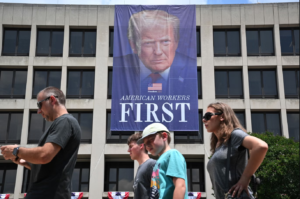
The Axon case is especially sensitive because it connects three politically charged issues: Trump’s personal stock trading, federal immigration enforcement, and the rapid expansion of law enforcement technology.
Axon itself has become a major player in debates over policing, surveillance, body cameras, artificial intelligence, and digital evidence. Supporters say its tools can improve accountability and officer safety. Critics warn that the same technology can expand surveillance, especially when used by federal immigration agencies.
For ICE, the proposed Taser purchase fits into a broader push to equip agents for more aggressive enforcement. For Axon, federal law enforcement contracts can become a valuable source of revenue. For Trump, the stock purchase has become a political problem because of its timing.
At this stage, the most important distinction is that scrutiny does not equal proof of wrongdoing. Public reports have not shown that Trump directed the ICE solicitation, that he traded on nonpublic information, or that Axon had knowledge of his investment.
However, the timing is enough to fuel calls for stronger ethics rules. Some lawmakers and watchdog groups have argued that presidents, members of Congress, Cabinet officials, and senior agency leaders should be restricted from trading individual stocks while in office.
The controversy is likely to continue as more details emerge about the ICE contract, Axon’s role, and Trump’s financial disclosures. If the contract moves forward, questions about whether Axon benefited from administration policy may become even louder.
For now, the case highlights a familiar problem in Washington: when public power and private investment overlap, even legal trades can create serious political consequences.