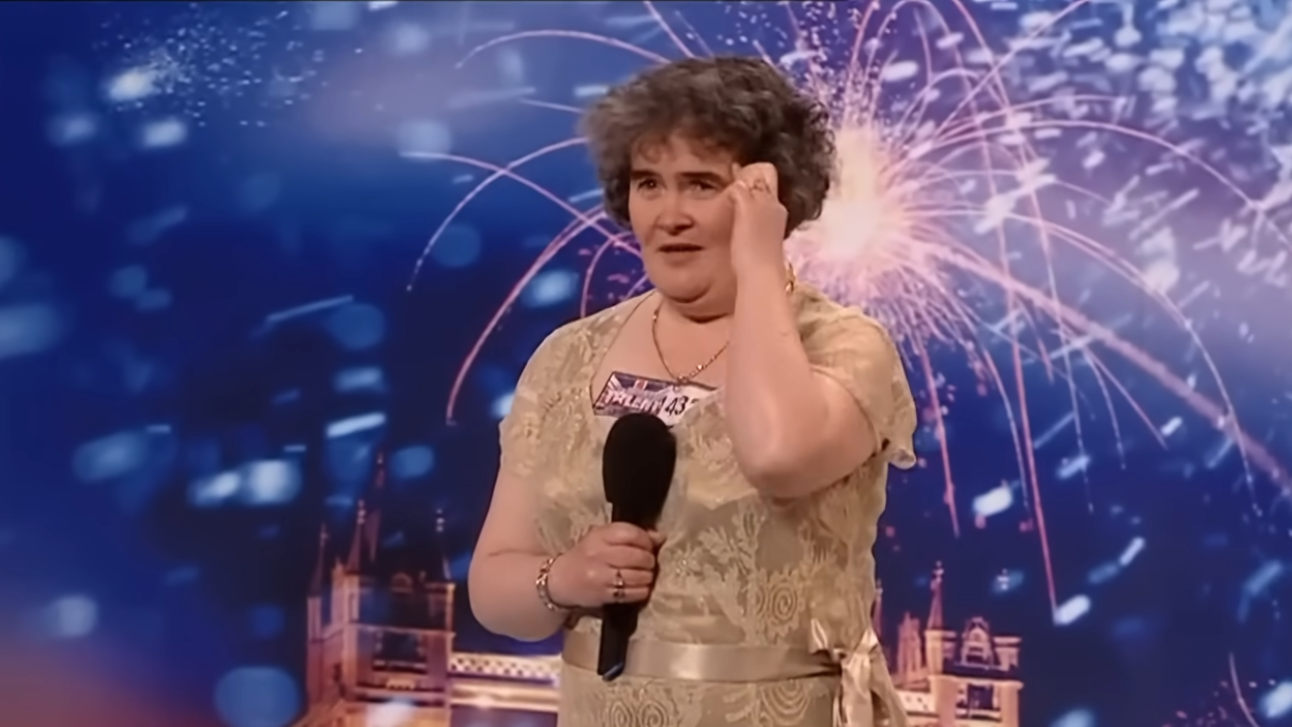
Susan Boyle’s first appearance on Britain’s Got Talent remains one of television’s clearest examples of why people should never judge talent by appearance, age or first impressions.
When the Scottish singer walked onto the stage in 2009, she was 47 years old and largely unknown outside her local community. She told the judges that she wanted to become a professional singer before choosing “I Dreamed a Dream” from the musical Les Misérables for her audition.
The atmosphere inside the theater initially appeared uncertain. Some audience members reacted skeptically to Boyle’s introduction, while judges Simon Cowell, Amanda Holden and Piers Morgan waited to discover whether she could support her ambitious dream.
Then she began singing.
Her First Notes Changed the Entire Room
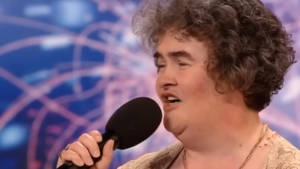
Boyle’s powerful voice immediately altered the mood inside the theater. The audience erupted into applause, and the judges reacted with visible surprise as she continued through the emotionally demanding song.
Britain’s Got Talent later described the performance as one of the most unforgettable auditions in the program’s history. The show emphasized that Boyle had shocked the panel with a performance few people expected when she first appeared onstage.
The audition became memorable not only because Boyle sang well, but because viewers witnessed thousands of people changing their opinions within seconds.
Nothing about the contestant had changed between her introduction and the first line of the song. The only difference was that the audience had finally heard her voice.
That rapid transformation turned the performance into a lasting message about assumptions and hidden talent.
The Video Became a Worldwide Internet Sensation
Boyle’s audition aired in April 2009, when online video was becoming an increasingly powerful way to share television moments worldwide.
Within days, the performance had attracted millions of online viewers and generated international media coverage. Early reports described Boyle as an unexpected singing sensation whose rendition of “I Dreamed a Dream” had spread rapidly beyond Britain.
The audition eventually became YouTube’s most-watched video of 2009, demonstrating the extraordinary global response to Boyle’s story.
Its success was especially remarkable because the performance did not rely on expensive effects, dancers or complicated production. Boyle stood alone with a microphone and delivered a song that allowed her voice and emotion to become the entire focus.
Why Viewers Connected With Susan Boyle
The audition offered audiences a simple but powerful story.
An unknown woman arrived with a dream.
People underestimated her.
She received an opportunity to perform.
Then she proved that their assumptions were wrong.
The Guardian noted at the time that Boyle’s appeal extended beyond technology and viral sharing. Her story represented the possibility that an ordinary person could still receive an unexpected opportunity and see a long-held dream become real.
Millions of viewers related to that message because many people have experienced being overlooked, underestimated or told that their opportunity has passed.
Boyle’s success suggested that talent does not disappear because someone is older or has followed an unconventional path.
She Finished Second but Built a Major Career
Susan Boyle advanced through Britain’s Got Talent and reached the Series 3 final. She ultimately finished second behind the dance group Diversity.
However, the result did not prevent her from becoming one of the most successful performers associated with the Got Talent franchise.
Later in 2009, she released her debut album, also titled I Dreamed a Dream. The album and the international attention surrounding her audition established Boyle as a professional recording artist rather than a short-lived television personality.
She subsequently released several studio albums and continued performing for audiences around the world. Her career demonstrated that the audition was not simply a viral surprise—it was the beginning of a lasting musical journey.
The Perfect Song for Her Breakthrough
“I Dreamed a Dream” was an especially appropriate choice for Boyle’s life-changing audition.
The song explores hope, disappointment and dreams that do not unfold as expected. Boyle performed those lyrics while finally receiving the public opportunity she had wanted for years.
That connection made the moment feel authentic.
The audience was not only hearing a technically strong voice. Viewers were watching someone sing about a dream while her own dream began taking shape on the stage.
The simplicity of the performance strengthened that emotional impact. There was no elaborate visual production to distract from the singer or the meaning of the song.
Boyle Later Returned to the BGT Stage
Ten years after the original audition, Boyle returned to Britain’s Got Talent and performed the song that had changed her life.
ITV described the return as a celebration of the moment an unknown singer had first amazed the judges and the country in 2009.
The return demonstrated how closely “I Dreamed a Dream” had become connected with Boyle’s public identity.
For viewers who remembered the original broadcast, the later appearance offered an opportunity to reflect on how dramatically one audition had changed her life. For younger audiences, it introduced the performance that helped define the early era of viral talent-show videos.
Why the Audition Still Matters
Susan Boyle’s audition continues to resonate because its message remains relevant.
People frequently make judgments based on appearance, age, confidence or social background. Boyle’s performance showed how unreliable those judgments can be.
She did not change herself to match the audience’s expectations. She simply received the opportunity to demonstrate what she could do.
Within minutes, uncertainty became applause, and an unknown contestant became a performer recognized around the world.
That is why the audition remains more than a famous singing clip. It is a reminder that extraordinary ability can exist in places people fail to notice.
Susan Boyle walked onto Britain’s Got Talent with a dream and a song.
By the time she left the stage, millions of people were ready to believe in both.