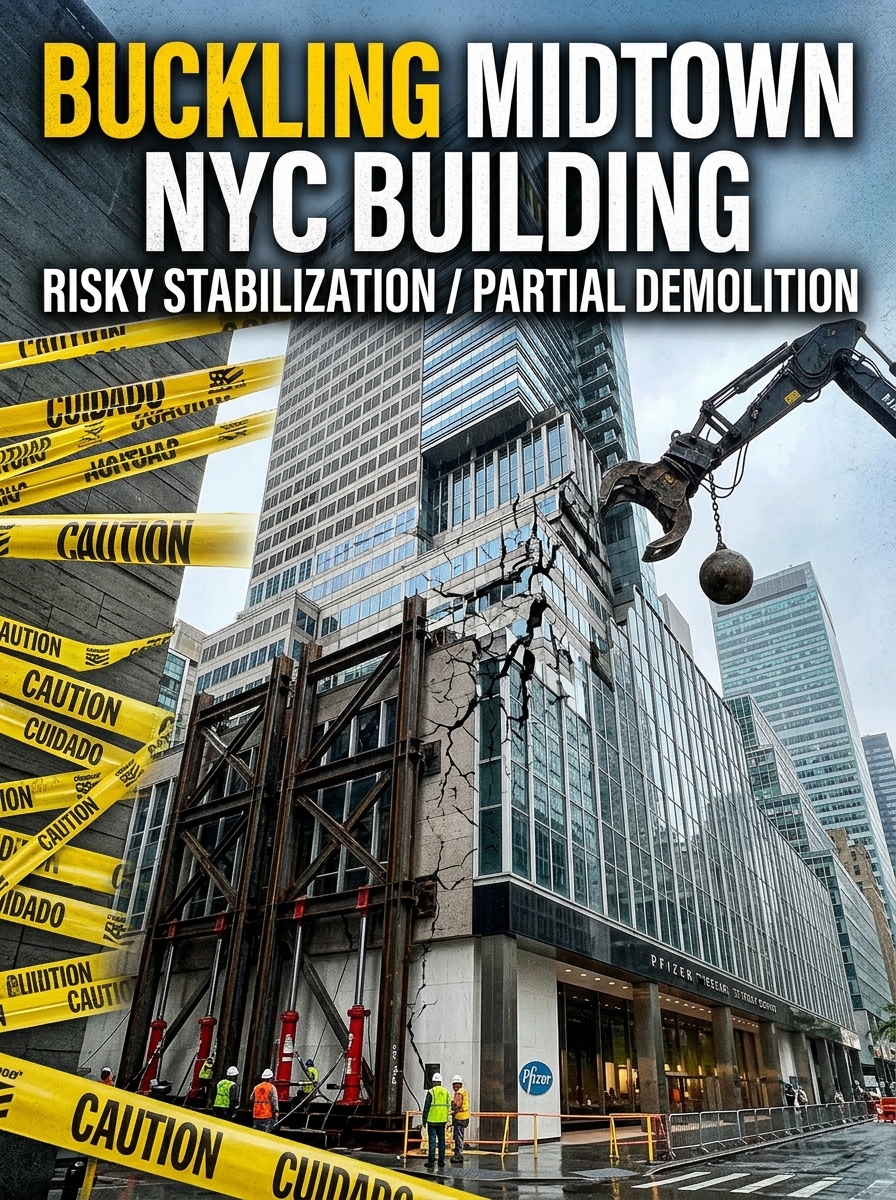
A Midtown Manhattan high-rise is facing emergency stabilization work and possible partial demolition after structural damage raised fears of a localized collapse.
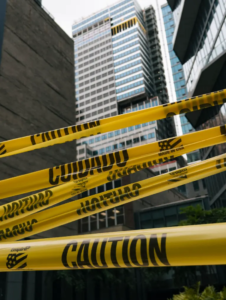
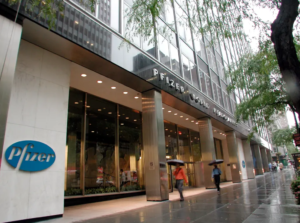
The building, located at 235 East 42nd Street, is the former Pfizer headquarters and is being converted into residential apartments. The 37-story structure sits in a busy Midtown corridor near Grand Central Terminal, the Chrysler Building, and the United Nations area.
The emergency began after workers noticed serious structural problems at the active construction site. Officials said two support columns buckled on the 21st and 22nd floors, while multiple floors began sagging under stress. Nearby buildings, including a school, hotels, and diplomatic offices, were evacuated as a precaution.
According to the New York Post, engineering experts believe the damaged section will likely require partial demolition because the affected columns and surrounding structural elements may not be repairable in place. Experts also warned that even stabilizing the building before demolition could be risky because crews must work near weakened steel and sagging floors.
Emergency crews and engineers moved floor by floor to check whether the building was still moving. City officials later said no additional movement had been detected, allowing contractors to begin temporary shoring work. Some evacuation orders were lifted after the structure was deemed stable late Tuesday.
Fire officials said the concern was not a total collapse of the entire tower, but a possible localized collapse in the damaged section. Because the building has a steel-frame structure, officials believed any failure would likely be limited rather than bringing down the whole building.
The project is part of one of New York City’s largest office-to-residential conversions. Developers plan to transform the former corporate office property into more than 1,600 apartments, but the structural failure has now placed the project under intense review.
Experts said the immediate priority is shoring up the weakened floors and columns so engineers can safely inspect the damage. Longer-term repairs may require removing and replacing the buckled columns, along with checking whether the load shifted into other parts of the building.
No injuries were reported, and construction workers were able to evacuate safely. Still, the incident caused major disruption in Midtown, with street closures, emergency vehicles, and nearby tenants forced out while officials assessed the risk.
The situation remains a reminder of how complex office-to-residential conversions can be, especially when older commercial buildings are modified with new floors, new layouts, and heavier structural demands. City officials and engineers are expected to continue monitoring the building while emergency repairs move forward.