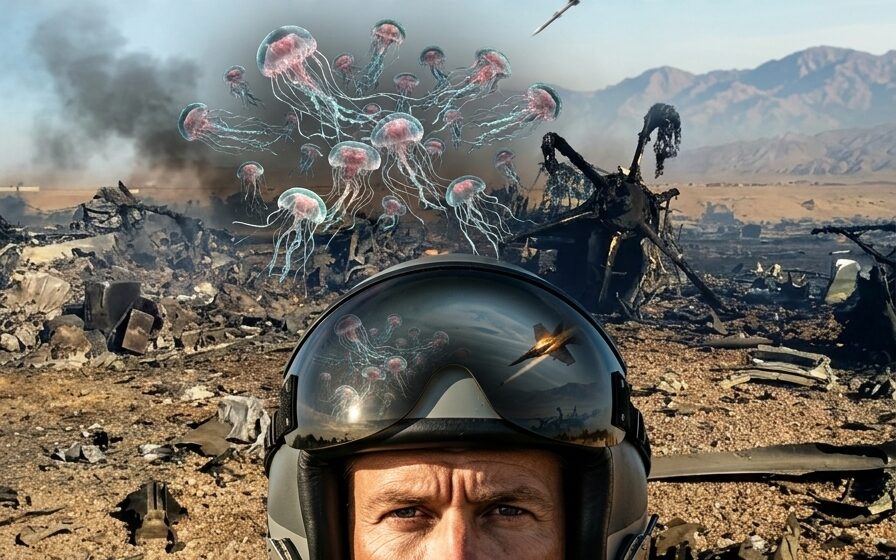

A U.S. fighter pilot who survived after his aircraft was shot down over Iran has reportedly described a bizarre encounter with what he called a “jellyfish-like” swarm of drones moments before the incident. This encounter is now being referred to as the ‘US Fighter Pilot Recalls ‘Jellyfish’ Drone Swarm Before Jet Was Shot Down Over Iran.’ In this account, the US Fighter Pilot Recalls ‘Jellyfish’ Drone Swarm Before Jet Was Shot Down Over Iran and shares the unusual details of his experience.
US Fighter Pilot Recalls ‘Jellyfish’ Drone Swarm Before Jet Was Shot Down Over Iran
According to reports citing individuals familiar with the pilot’s post-mission debriefing, the aviator recalled seeing multiple drones moving together in a coordinated formation that appeared unlike anything he had previously encountered. The unusual aerial pattern reportedly resembled a giant jellyfish, with larger drones positioned above and smaller drones hanging beneath them like tentacles.
As the US Fighter Pilot Recalls ‘Jellyfish’ Drone Swarm Before Jet Was Shot Down Over Iran, he emphasizes the unprecedented nature of the drone formations he witnessed.

One source familiar with the account said the pilot described the sight as “real alien” technology because of the way the drones appeared to move in unison. Intelligence officials have reportedly been analyzing the description as they seek to understand whether Iran has developed new swarm-drone capabilities.
During the debriefing, the US Fighter Pilot Recalls ‘Jellyfish’ Drone Swarm Before Jet Was Shot Down Over Iran, explaining how the drones seemed to synchronize their movements.
The pilot was flying an F-15E Strike Eagle when the aircraft was brought down over Iranian territory in April 2026. The exact cause of the shootdown remains under investigation, and officials have not publicly concluded whether the drone formation directly contributed to the loss of the aircraft.
Military analysts say swarm-drone technology has become an increasingly important part of modern warfare. Rather than operating individually, drone swarms can share information, overwhelm air defenses and create confusion for enemy pilots and radar systems.
According to reports, the pilot described the formation as resembling a “minefield of drones” suspended in the sky. Investigators are now examining whether the drones may have been part of a coordinated defensive network designed to support Iranian air-defense operations.
This description plays a crucial role as the US Fighter Pilot Recalls ‘Jellyfish’ Drone Swarm Before Jet Was Shot Down Over Iran, raising questions about the technology’s origin.

The incident marked one of the most dramatic aerial losses of the conflict. Both crew members aboard the F-15E ejected after the aircraft was hit. The pilot was rescued within hours, while the aircraft’s weapons systems officer faced a much more difficult ordeal after landing in remote mountainous terrain.
The shocking incident has left many wondering, as the US Fighter Pilot Recalls ‘Jellyfish’ Drone Swarm Before Jet Was Shot Down Over Iran, what implications this technology may have for future warfare.
According to U.S. officials, the weapons systems officer evaded capture for more than a day while hiding in Iran’s Zagros Mountains. American forces later launched a complex rescue operation involving special operations personnel, intelligence assets and extensive air support. The mission ultimately succeeded in recovering both crew members.
The account has sparked renewed debate about the future of drone warfare. Experts note that nations around the world are investing heavily in autonomous and semi-autonomous drone systems capable of operating in coordinated groups.
As the narrative unfolds, it becomes clear why the US Fighter Pilot Recalls ‘Jellyfish’ Drone Swarm Before Jet Was Shot Down Over Iran continues to captivate military analysts worldwide.
While drone swarms have been discussed for years by military planners, reports suggesting a highly organized “jellyfish” formation have generated significant interest among defense analysts. Some experts believe such formations could complicate traditional air-combat tactics and challenge existing detection systems.

Questions remain about how accurately the pilot remembered the encounter. Reports indicate that investigators have considered whether injuries sustained during the shootdown could have affected portions of his recollection. Nevertheless, intelligence officials continue to evaluate the information because of its potential significance.
This ongoing investigation is significant, especially since the US Fighter Pilot Recalls ‘Jellyfish’ Drone Swarm Before Jet Was Shot Down Over Iran, highlighting the need for further analysis.
The incident comes amid growing concern about the rapid advancement of unmanned aerial technology worldwide. Military planners increasingly view drone swarms as one of the most important emerging threats on the modern battlefield.
For now, the mystery surrounding the reported “jellyfish drones” remains unresolved. As investigators continue examining evidence from the shootdown, defense experts will be watching closely to determine whether the pilot witnessed a previously unknown capability or an unusual tactical deployment of existing drone technology.
In the context of this unfolding story, the US Fighter Pilot Recalls ‘Jellyfish’ Drone Swarm Before Jet Was Shot Down Over Iran, offering insights into future technological advancements.

Image Alt Text: Illustration of a jellyfish-like drone swarm reportedly observed by a U.S. fighter pilot before his aircraft was shot down over Iran.
Tags: Iran, US Air Force, F-15E, Drone Swarm, Military News, Defense Technology, Iran War, Fighter Pilot, Aviation News, World News
In conclusion, the account where the US Fighter Pilot Recalls ‘Jellyfish’ Drone Swarm Before Jet Was Shot Down Over Iran remains a pivotal moment in the discussion of modern drone warfare.